
Description
LOCATION: The Bahamas
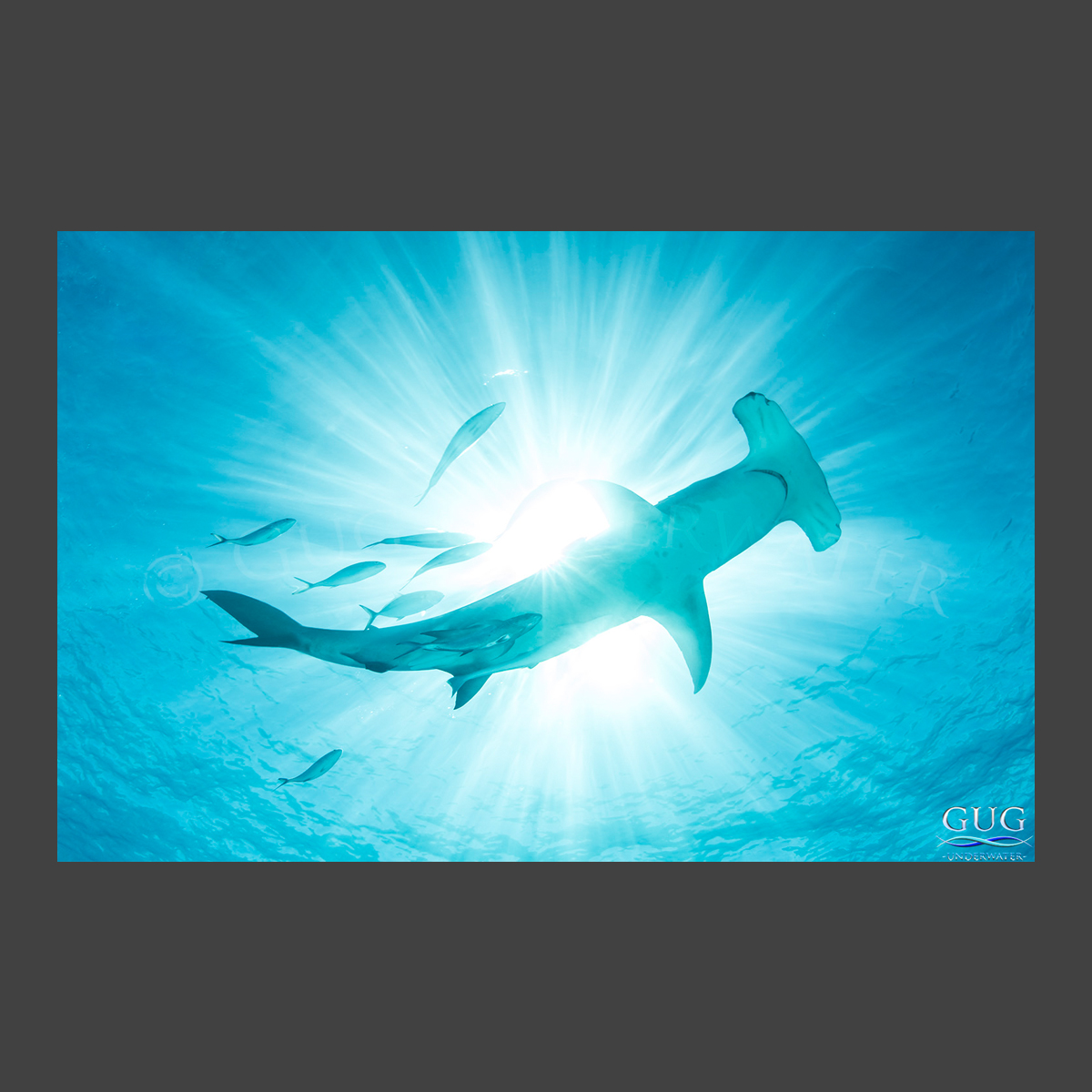
STORY BEHIND THE SHOT: So wonderful to see an apex predator like this great hammerhead shark (Sphyrna mokarran) up above, with the light rays broken by the giant’s 11′ body. But there are no random encounters that produce this angle – it takes time, patience, and technique. At the right time of year, solitary great hammerheads migrate through a few key spots in The Bahamas. With relatively shallow, crystal clear water, and white sand below, it is a terrific location for laying a scent bait (chum). The day before, we’ll get fish scraps from local Bahamian restaurants, and load up a very stinky cooler, and pack a specially-made heavy aluminum box to take the chum underwater once we locate a shark. But great hammerheads tend to hug the seafloor when the chumbox is present. They generally tolerate other species like bull, nurse, and reef, but when equally-sized tigers show up, there can be some pecking order issues.
Sure, non-divers assume that it’s all about the feeding frenzy. And Hollywood and the news will tell you that I must be dead already. But the reality is that 99.99% of the time, it’s extremely calm & organized. The sharks realize they’re getting an easy meal, and they don’t want any trouble, so they behave. Sharks (and particularly hammerheads) are far more timid than most people think. As a matter of fact, most species are almost impossible to approach within photography distances without chum. No, I’m not talking about whale sharks, horn sharks, wobbegongs, etc. – I’m referring to the sharky-type sharks, like those in the Requiem family. So sure, there’s the eternal debate of is chumming a good or bad practice. And that’s too long of a conversation for here, but I can tell you with authority 2 things: 1) without chumming, 99% of the good shark photos you’ve seen wouldn’t exist, and tens of thousands of divers who have become activists for shark conservation would never had their introduction to fire that passion. And 2) there is a right and a wrong way to do it – I’ve been chumming, hand-feeding, rolling them into tonic immobility, and removing fishing hooks from their faces since I was about 16 years old, and I’ve now had the opportunity to work with and photograph several dozen species. And here I am… two arms & two legs. There are good shark handling operations, and bad/inexperienced shark handling operations. Choose wisely.
Okay, got off topic there! Stream-of-consciousness writing sometimes takes over. I was talking about the rarity of it him being directly above me. It is rare. But it’s not luck! It’s planning. The photo exposure settings are drastically different when shooting 45′ down along the sandy sea floor, as opposed to up in the mid-water column and shooting straight up into the sun. But the lucky part for me as a photographer, is the entourage of fish! “Shadowing” the hammerhead, are several yellowtail snapper, bar jacks, and a horse-eye jack, and clinging to him there are several sharksucker remoras. I love the “family” element they bring to the composition. Anyway, I hope you enjoy this calm moment in a beautiful, sunny environment with a apex predator. Love & respect is always > fear and misunderstanding.
While there are plenty of shark photographs to choose from in the the Fish Faces and SeaScapes Collections, if you’re simply in love with hammerhead sharks, be sure to also check out Bad Mammer Hammer, another great hammerhead shark from the Bahamas, and the simply named, Hammerheads, which features the silhouette of a school of scalloped hammerhead sharks from Cocos Island on the Pacific side of Costa Rica.
PURCHASING A PRINT: While we always offer customizations, we do suggest that Belly of the Beast be kept at or near its original 3:2 horizontal aspect ratio. It can be cropped somewhat into a panoramic, but the best way, as always, is to allow us to do a Virtual Installation for you, which starts with you emailing us a photo of your space.